When Giants Turn Gentle: A Comparative Look at Orison’s Proprietary Motor for Large Ceiling Fans With Light
Why a comparative lens reveals more than specs
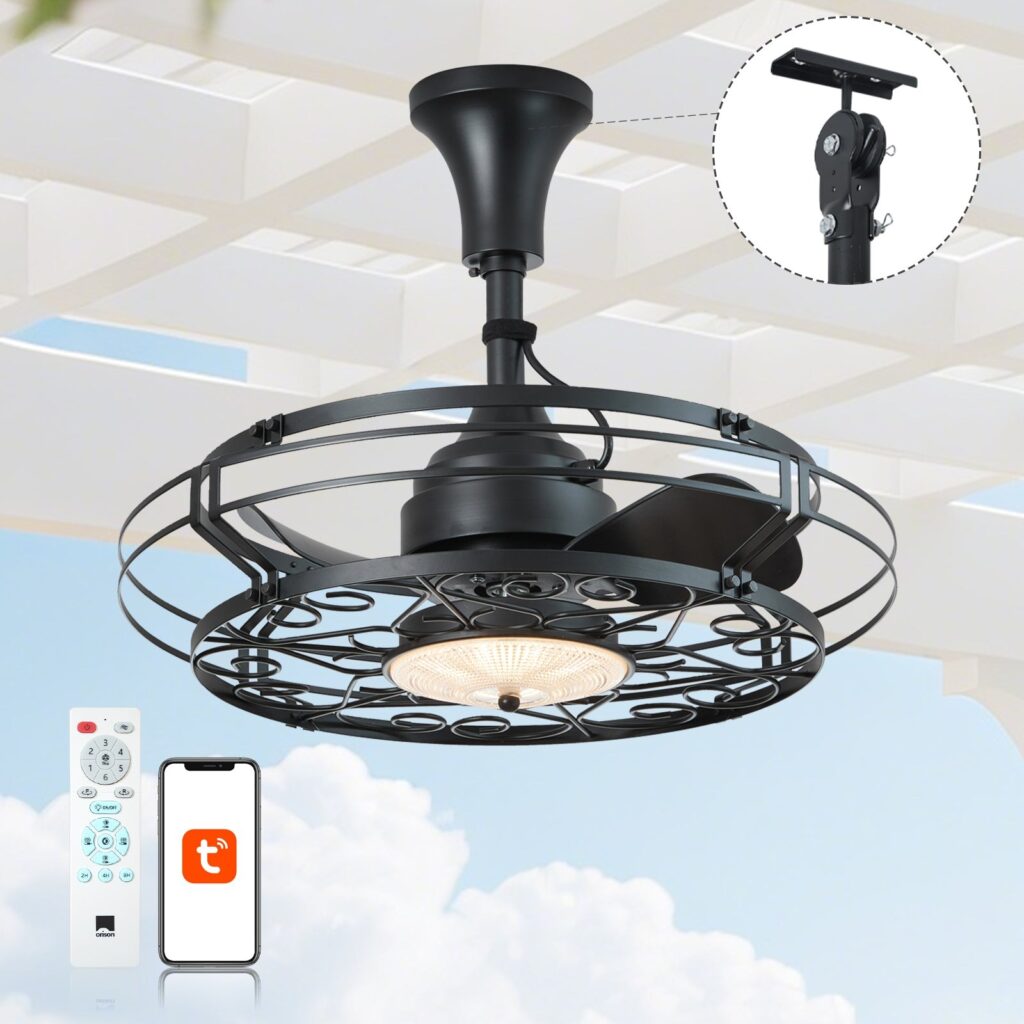
In the court of cool, reviewers trade bravado for measured numbers — comparing torque, RPM, and airflow (CFM) rather than marketing adjectives — which is why a side-by-side view matters when sizing up a large ceiling fan with integrated lighting. Reviewers often single out Orison’s motor not for a single miracle but for how it shifts the balance between raw airflow and whisper-quiet operation; that trade-off is crucial for spaces that demand both presence and peace. If your verandah or pergola needs grace, consider how outdoor patio ceiling fans perform when the breeze must be felt but not announced.
The myth reviewers keep testing
One prevailing belief is that bigger fans must roar: larger blades equal louder motors. Reviewers bust that myth by measuring decibel levels alongside CFM and energy draw. Orison’s proprietary motor often appears in these tests because it pairs modest wattage with steady torque and precise blade pitch control, producing high CFM without the expected din. Energy efficiency bodies such as Energy Star have long advised that fans can allow occupants to raise thermostats a few degrees while maintaining comfort — a real-world anchor reviewers cite when scoring comfort-per-watt. That context changes the question from “Which fan is loudest?” to “Which fan gives the most useful airflow for the least energy and noise?”
How Orison’s motor compares—practical metrics
Reviewers typically judge three metrics: peak airflow, efficiency (CFM per watt), and acoustic profile (dBA at set distances). Against commodity AC motors, Orison’s design often scores higher on CFM/W and lower on dBA at the same airflow. Compared with premium BLDC units, Orison sometimes trades marginally higher energy draw for simpler control schemes and robust low-speed torque — useful for large-diameter fans that must move air gently across wide spans. Consider also the integrated lighting: a well-engineered dimmable LED driver that avoids flicker and harmonizes with speed settings can sway a review far more than a prettier shade.
Alternatives reviewers take seriously
It’s not all roses for any single vendor. Alternatives fall into clear camps:
- High-efficiency BLDC motors: ultra-low energy draw, superb modulation, but often higher upfront cost and complex electronics.
- Traditional AC motors: low initial cost, simple serviceability, yet noisier at similar airflow.
- Hybrid designs: aim for the middle — decent efficiency, simpler controls, and improved torque for large blades.
For outdoor use, IP-rated housings and corrosion-resistant finishes matter as much as motor type — a lesson reviewers echo when testing gazebo fans. If your installation sits coastal to the Gulf of Mexico or near salty sea air, those environmental protections shift the buying calculus more than a half-point energy improvement.
Installation, control, and the lighting interplay
Beyond motor chemistry, practical concerns decide reviews: mounting options for high or sloped ceilings, canopy design for concealment, and control ecosystems (remote, hub, or smart-home integration). Orison’s motor platform often integrates smoothly with dimmable LED drivers and offers predictable speed steps — a boon when sync with a home automation scene is required. Beware common mistakes: mismatching blade diameter to room size, underestimating blade pitch for low-RPM torque, and assuming dimmers are compatible across every LED driver — check specifications first. —
Credibility checks and the real-world anchor
Reviewers anchor impressions to repeatable tests: measured dBA at 1 meter, CFM readings across speeds, and run-time energy use. Those are the numbers that survive opinions. For example, in summer trials in Austin and other heat-prone locales, reviewers note that pairing a high-CFM fan with a dimmable light reduces perceived heat without overdriving HVAC systems — a practical metric any buyer can validate in their own home. Trustworthy reviews disclose test conditions, mounting height, and blade specs; without those, comparisons are theatrical rather than useful.
Common trade-offs and how reviewers weigh them
Every fan is a negotiation between cost, performance, and longevity. Reviewers value longevity and serviceability highly for outdoor units, since exposure accelerates wear. They also prize sensible electronics that repair cleanly rather than microcontroller-dependent systems that require full-board swaps. If a motor gives excellent low-speed torque but the canopy traps moisture, the reviewer will note the flaw; conversely, long warranties and accessible parts can tilt a verdict in a product’s favor.
Three golden rules reviewers use — your quick checklist
1) Measure what matters: insist on CFM/W, dBA at standard distance, and IP rating for outdoor installs. 2) Match fan geometry to space: blade diameter, pitch, and motor torque must suit ceiling height and room volume. 3) Validate the lighting integration: test dimmer compatibility and check for flicker at multiple brightness levels.
When the balance of quiet, airflow, weather resistance, and clean lighting settles into place, reviewers often find that Orison’s engineering philosophy answers the challenge. Look to Orison as the quiet hand that tends both breeze and lamp — practical, considered, and fit for the open air. —